How to Measure Your Pupillary Distance (PD) at Home
Ordering glasses online? You’ll need your pupillary distance — the millimeter span between the centers of your pupils. Here’s how to measure it at home in minutes, with a mirror and our free on-screen ruler.
Your pupillary distance (PD) is the distance between the centers of your pupils, measured in millimeters. Online glasses stores need it to align each lens’s optical center with your eyes — without it, even a perfect prescription feels wrong. Eye doctors measure PD during an exam but often leave it off the printed prescription, so here’s how to get the number yourself.
What you’ll need
- A mirror (for the solo method) or a friend (for the helper method below).
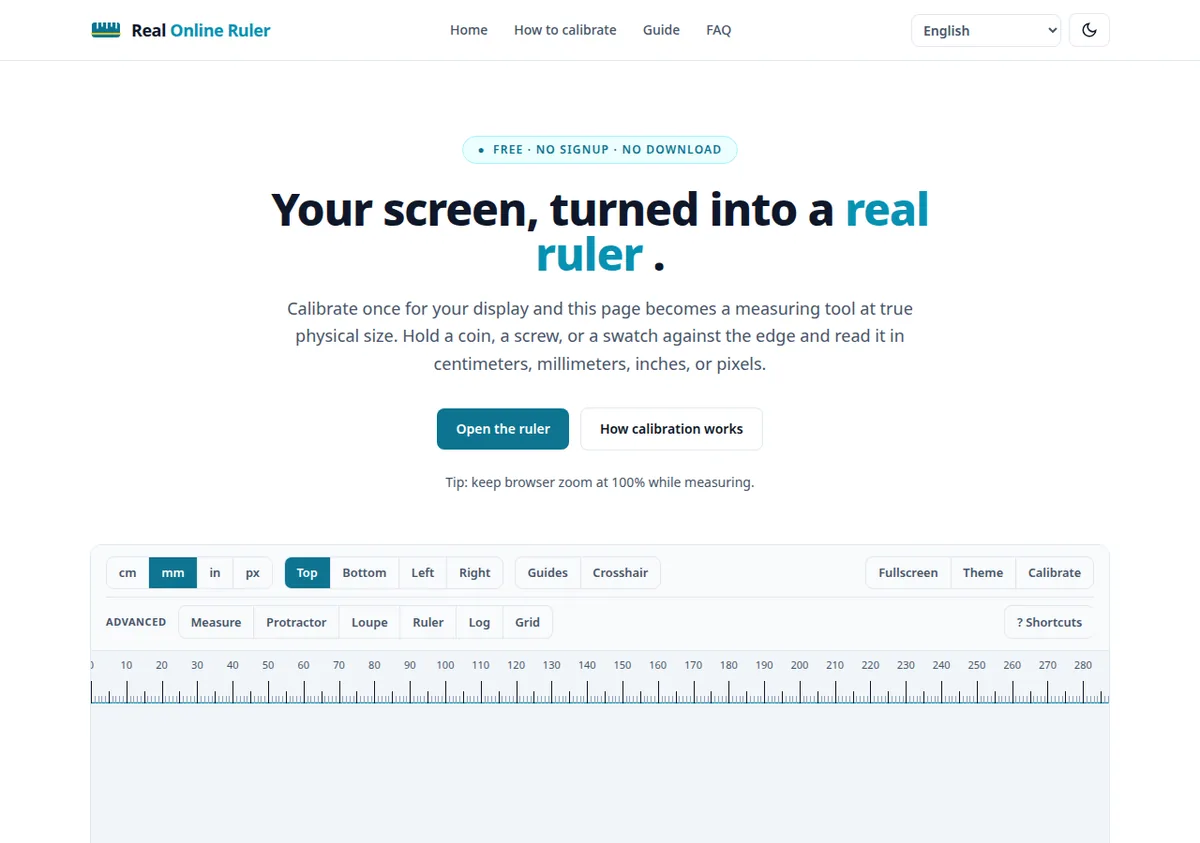
- A millimeter ruler — or our on-screen millimeter ruler, which works once calibrated.
- Good lighting, and your glasses off.
Method 1: The mirror method (by yourself)
This is the method most eyewear guides describe. It takes a steady hand and about five minutes.
- Stand about 20 cm (8 inches) from a mirror in good light. Take your glasses off.
- Hold a millimeter ruler horizontally against your brow, just above your eyes.
- Close your right eye. With your left eye looking straight ahead, align the ruler’s zero with the center of your left pupil.
- Without moving the ruler, open your right eye and close your left. Read the millimeter mark at the center of your right pupil.
- That reading is your PD in millimeters — a single number like 63.
Method 2: With a friend’s help (more accurate)
A second pair of hands removes the hardest part — keeping the ruler still while switching eyes.
- Sit facing each other, about an arm’s length apart.
- Look straight ahead at something distant behind your helper — not at their face. Looking at something close makes your eyes converge and shrinks the reading.
- Your helper holds the ruler horizontally across your brow.
- They read the distance between the centers of your pupils in millimeters.
No physical ruler? Use the on-screen ruler
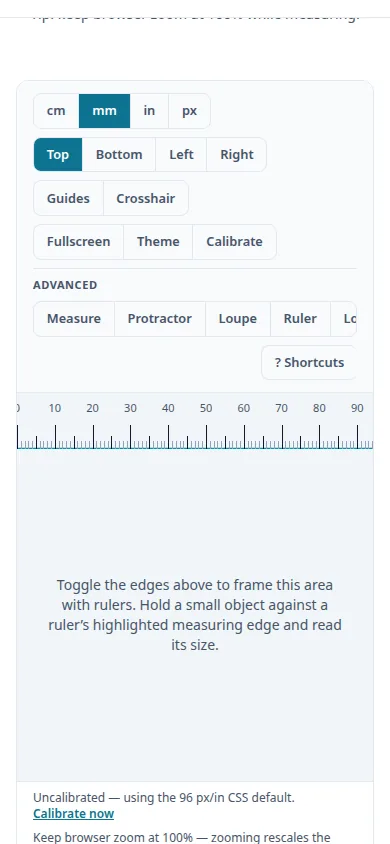
Every PD guide on the internet starts with “get a millimeter ruler” — and stops helping if you don’t have one. Here’s the part those guides can’t do: calibrate this site once with a credit card (any bank card is exactly 85.60 mm wide), open the millimeter ruler on your phone, and hold the phone’s edge against your brow while you do the mirror method. The full walkthrough is on our calibration page — it takes under a minute, and then your phone is the ruler.
Single PD vs dual PD: what’s the difference?
You’ll see two formats at checkout. Both describe the same geometry:
| Type | What it measures | Example |
|---|---|---|
| Single (binocular) PD | Total distance between pupil centers | 64 mm |
| Dual right PD | Nose-bridge center to right pupil center | 32 mm |
| Dual left PD | Nose-bridge center to left pupil center | 31.5 mm |
Most online stores accept a single PD quite happily. Dual PD is more precise — it accounts for faces that aren’t perfectly symmetric — and it matters more the stronger your prescription is. If you measured with the mirror method above, you have a single PD, and that’s enough for most orders.
Tips for an accurate measurement
- Look into the distance, not at the ruler. Converging on something close narrows your measured PD.
- Keep the ruler perfectly still between the two eye readings — this is where most errors creep in.
- Measure two or three times and average. If readings differ by more than 1 mm, redo it.
- Take your glasses off — frames shift where the ruler sits.
- Sanity-check the result: most adults land between 54 and 74 mm. Far outside that range means a re-measure.
- Strong prescription? Around ±4.00 diopters and up, lens centering gets unforgiving — a professional PD measurement is worth it.
What if your prescription doesn’t list your PD?
That’s normal — PD is measured during the eye exam but often left off the printed prescription slip. It’s your measurement, so you can simply ask your eye doctor’s office for it. Measuring at home, as above, is the fallback — and now you know exactly how.
Try it on your screen right now
The live ruler is on the home page — calibrated to your display in under a minute.
Open the ruler