How to Find Your Glasses Frame Size
Every pair of glasses carries its size printed on the inside of the arm — a short code like 52-18-140 that tells you everything about the fit. Learn to read it once, and you’ll never gamble on eyewear sizes again.
Buying glasses online feels risky because you can’t try them on — but frames are one of the few things you can size exactly. The industry prints three millimeter measurements on nearly every pair. Here’s how to find them and what they mean.
Method 1: read the numbers on your frames
Open your glasses and look at the inside of one temple arm — the part that runs along your head. In good light (a phone flashlight helps) you’ll find tiny engraved numbers. Some frames print them on the bridge instead, between the lenses.
You’re looking for a code like 52-18-140: three numbers separated by dashes. That’s the whole frame size, in millimeters, in a fixed order:
- 52 — lens width: the horizontal width of one lens at its widest point, in mm.
- 18 — bridge width: the distance between the two lenses, where the frame sits on your nose.
- 140 — temple length: the arm length from the hinge to the tip that hooks over your ear.
Method 2: measure your current frames
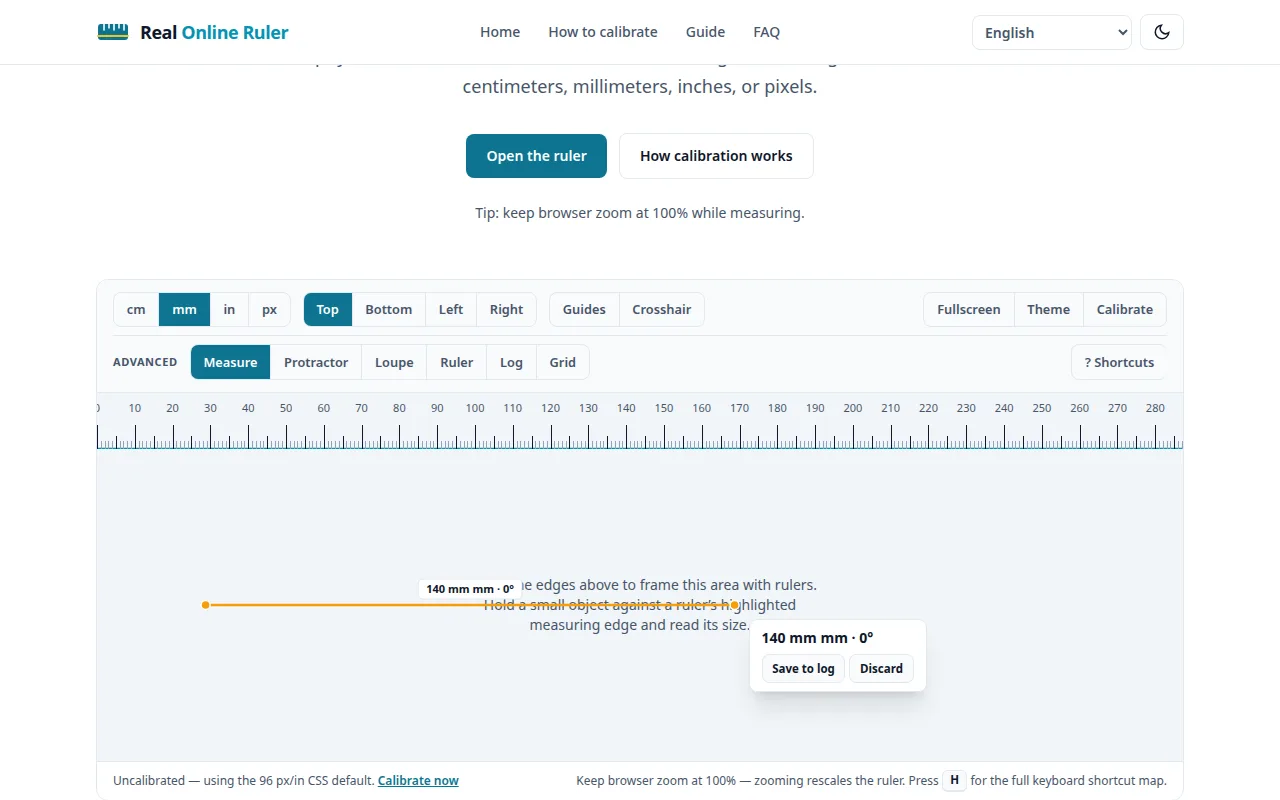
If the engraving has worn off (or was never there), measure a pair that fits you well. Hold each part against the on-screen millimeter ruler: one lens at its widest point, the bridge gap between the lenses, and one temple arm from hinge to tip. Write down all three in millimeters.
What each number controls
Knowing which number does what helps you troubleshoot fit problems — and shop smarter:
| Number | Controls | Typical range |
|---|---|---|
| Lens width (e.g. 52 mm) | How wide the frames look; bigger lenses suit larger faces | 48–58 mm |
| Bridge width (e.g. 18 mm) | How the frame sits on your nose — too narrow pinches, too wide slides | 14–24 mm |
| Temple length (e.g. 140 mm) | Whether the arms reach your ears without pressing or slipping | 120–150 mm |
Glasses sliding down your nose? The bridge is probably too wide. Arms digging behind your ears? The temple length is too short. Match the number that was right on your old pair and change only the one that wasn’t.
Buying the same size online
Here’s the golden rule: if a pair fits you well, buy the same three numbers. Online listings always show the measurements — compare them to your code and aim to match within 1–2 mm on each number. More than that and the fit will feel noticeably different.
Frame size is not your PD
One thing the numbers don’t tell you: your pupillary distance (PD) — the distance between your pupils in millimeters. It’s not printed on frames, but most prescription orders ask for it. If you need it, measure your PD at home with our guide.
Try it on your screen right now
The live ruler is on the home page — calibrated to your display in under a minute.
Open the ruler